
VARNISH REMOVAL UNIT (VRU) · PURE RESIN & HYBRID SKIDS (10–30 L/MIN)
Varnish Removal Unit (VRU):
Cut High MPC < 15, Stop Servo Sticking & Bearing Temp Spikes
Remove dissolved polar varnish precursors and sub-micron oxidation sludge 24/7 online without unit shutdown or
costly full oil flushes — led by our flagship
WMVD Pure Ion-Exchange Resin VRU (1 kW electric or 0.45–0.69 MPa air-driven), alongside
WVDJ (varnish + water),
WVD (electrostatic + resin), and
WMN small-tank units.
Match Your Varnish Load, Water Level & Tank Size to the Right VRU
Standard 3–10 μm mechanical cartridges cannot trap dissolved varnish molecules at 40–60°C. Start with our flagship pure ion-exchange resin WMVD for dry reservoirs (< 100 ppm water), or pair WVDJ, WVD, and WMN below when steam-seal water, heavy suspended sludge, or compact < 1,000 L tanks apply.
High MPC (> 15–30) / Servo Sticking / Bearing Hot Spots → Pull MPC < 15
Imported Dow resin + 2-stage mechanical guard · Electric 1 kW or Air-Driven · Built-in hoist
FLAGSHIP PURE RESIN VRU · WMVD-I / WMVD-II / WMVD-III
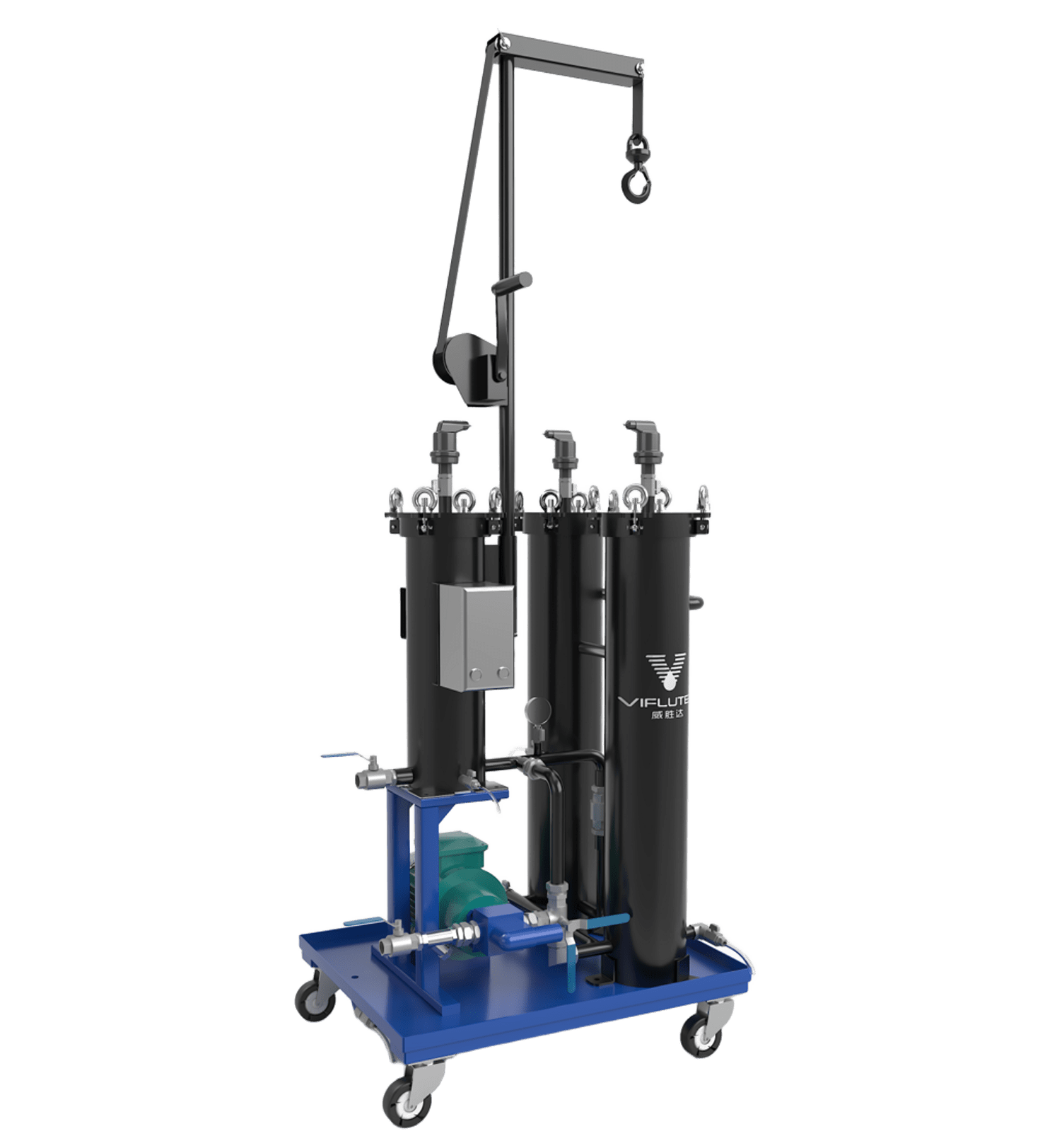
WMVD Pure Ion-Exchange Resin VRU
Engineered for sites and regional plant standards specifying dedicated chemical ion-exchange resin adsorption. Imported Dow ion-exchange resin strips dissolved polar varnish precursors, gums, and acidic degradation products 24/7 at operating temperature, lowering MPC and acid number while restoring oil solvency to re-dissolve legacy deposits online.
Flow Rate: 10 / 20 / 30 L/min (600–1,800 LPH)
Target / Media: MPC < 15 · Imported Dow Resin
Drive Options: 1 kW Electric OR 0.45–0.69 MPa Air
Size / Weight: 800×650×2,200 mm (w/ Hoist) · 130–186 kg
Best Fit: Gas & steam turbines, centrifugal compressors, and precision hydraulics running petroleum lube oils (< 100 cSt, < 80°C) needing compact mobile operation, 1-person winch canister swaps, quick-connect 5 m hoses, and optional zero-spark pneumatic drive.
Boundary: Strict dry-oil limit: inlet water must stay < 100 ppm, oil viscosity < 100 cSt, and oil temperature < 80°C. If steam-seal water exceeds 100 ppm, specify WVDJ below.
3-IN-1 VARNISH + WATER SKID · WVDJ-20 / EX-PROOF WVDJ-20-IIC
WVDJ Dehydration & Varnish Removal Unit
Integrates suction filtration, parallel sub-micron electrostatic collection and DICR™ ion-exchange resin stages, guard filtration, and two-stage coalescing-separation dehydration in one online skid to capture varnish while separating co-existing free and emulsified water.
Flow Rate: 20 L/min (1,200 LPH)
Varnish / Water: MPC ≤ 8 · Water ≤ 100 ppm
Power / Protection: 1.2 kW · IP55 / Ex d IIC IP56
Weight / Footprint: 550 kg (IP55) / 650 kg (Ex IIC)
Best Fit: Steam turbines, petrochemical drive turbines, expanders, and rotating machinery in high-humidity sites with chronic shaft-gland steam leakage plus elevated varnish risk.
Boundary: Coalescing separates free/emulsified water but does not flash-evaporate dissolved moisture like vacuum dehydration or handle severe flooding alone; drain separated water sump regularly.
Combines a circular high-voltage electrostatic field with DICR™ ion-exchange resin to remove suspended sub-micron sludge and dissolved polar varnish simultaneously, peeling hard deposits from bearing pads online without unit shutdown.
Models: WVD-I / WVD-II (Non-Ex & Ex)
Power / Guard: 1 kW · 10 μm Protective Filter
Protection / Cert: IP55 / IP56 Ex-Proof · CE
Weight: 280–340 kg (Std) / 420–525 kg (Ex)
Best Fit: Petrochemical ethylene & cracked-gas centrifugal compressors, syngas compressors, ASU compressors, and gas turbines (ISO VG 32/46) where specs explicitly call for combined electrostatic + resin stages.
Boundary: Strictly dry oil only (≤ 100 ppm water, zero free bottom water). If your plant standard specifies pure ion-exchange resin or compressed-air pneumatic drive, specify WMVD.
Confined Space + Wear Debris, Trace Water & Insoluble Sludge → Depth Polish
Compressed layered cellulose depth media · Detachable compact offline unit
COMPACT DEPTH MEDIA FILTER · WMN SERIES (< 1,000 L TANKS)
WMN Depth Media Fine Filter
Compact, detachable depth-filtration unit engineered for confined spaces and small oil reservoirs (< 1,000 L). Tightly compressed layered cellulose media traps fine wear debris, absorbs trace free/emulsified water, and captures insoluble oxidation sludge offline.
Target Tank Size: Small Reservoirs (< 1,000 L)
Media Type: Layered Cellulose Depth Cartridges
Contaminants: Fine Particles + Trace Water + Sludge
Installation: Compact Detachable Offline Bypass
Best Fit: Hydraulic power units (HPUs), industrial gearboxes, wind turbine gearboxes, marine equipment, and tight auxiliary reservoirs needing 3-in-1 offline polishing.
Boundary: Low-flow small-tank bypass only (< 1,000 L) — not a substitute for WMVD / WVDJ / WVD resin skids on 10–40 m³ turbine reservoirs or high dissolved varnish loads; cellulose absorbs trace water only up to saturation.
Built-In Serviceability & Flow Architecture (WMVD): Equipped with suction strainer, negative-pressure gauge, dedicated inline particle-counter test ports, oil sampling valves, automatic air vents on top caps, 5 m quick-connect steel-braided hoses, and a self-locking hand-winch hoist for effortless canister changeouts.
Dry vs. Wet Selection & Bottom-Drain Rule: Free water settles at the tank bottom while mid-level samples can read dry. Always check moisture from the active bottom drain first: use pure-resin WMVD (or hybrid WVD) when water is < 100 ppm; choose WVDJ when water exceeds 100 ppm.
FIELD RESULTS & MEASURED MPC DATA · REAL ROTATING MACHINERY
Real Machines. Measured MPC Drops & Bearing Temperature Recovery.
Every photo below is a working unit at a customer site. Compare real documented bearing temperature drops and ASTM D7843 MPC reductions achieved during continuous online kidney-loop operation.
Field Proven Across Complexes & Major Turbine Oils:
PetroChinaSinopecCNOOCShell Turbine OilsMobil Turbine OilsKunlun & Great Wall Oils
PETROCHEMICAL CRACKED GAS COMPRESSOR
Thrust Bearing Temperature Drop & MPC Recovery (37 Days)
Online varnish removal reduced thrust bearing temperature from 106°C peak down to 90°C in 37 days while dropping ASTM D7843 MPC from 5.9 to 1.2 without stopping the compressor.
Continuous online kidney-loop varnish removal pulled ASTM D7843 MPC down from 22.4 to 2.5 within 1 month and stabilized 82°C bearing temperature fluctuations.
Online conditioning lowered stage-3 bearing temperature from 94.1°C to 84.2°C and cut MPC from 14.0 to 1.4 in approximately 1 month of continuous bypass operation.
Match the Right Varnish Removal Technology to Your Oil State & Plant Standard
Different industries, regional plant standards, and contamination profiles favor different varnish removal mechanisms — rather than a one-size-fits-all approach. Whether your specification prefers dedicated pure Dow ion-exchange resin (WMVD) for continuous < 80°C soluble varnish control and pneumatic hazardous-area duty, dual-stage electrostatic + resin (WVD) for combined sub-micron carbon sludge and polar precursors, or 3-in-1 dehydration + varnish removal (WVDJ) where steam-seal water coexists, VIFLUTER engineers and manufactures all architectures in-house.
Compact mobile chassis (800 × 650 × 2,200 mm, 130–186 kg) with an integrated self-locking hand-winch davit hoist for 1-person resin canister replacement, quick-connect 5 m hoses, automatic air vents, and inline sampling / particle-counter ports.
Available in 1 kW electric (380V / 415V 50Hz, 480V 60Hz, custom Ex-proof motors) or 100% compressed-air drive (0.45–0.69 MPa) for zero-spark hazardous gas-turbine and petrochemical decks.
Objective Technology & Water-State Matching
R&D and Pre-Sales Process Engineers evaluate your plant specification, reservoir volume, suspended sludge load, bottom-drain moisture (< 100 ppm → WMVD or WVD; > 100 ppm → WVDJ), and ASTM D7843 MPC trend before recommending a configuration.
Proven operating experience across PetroChina, Sinopec, and CNOOC complexes running Shell, Mobil, Kunlun, and Great Wall turbine oils — plus 2-day dispatch on routine resin canisters and spare elements.
Need sizing across WMVD (pure resin), WVD (hybrid), or WVDJ (varnish + water)?
Send machine type, tank volume, MPC reading, and bottom-drain water ppm for sizing.
Key Engineering & Purchasing Questions Before You Specify
Practical answers for reliability and maintenance engineers comparing pure ion-exchange resin (WMVD), electrostatic + resin hybrids (WVD / WVDJ), ASTM D7843 MPC targets, L/min sizing, and hazardous-area pneumatic drive.
Pure Ion-Exchange Resin (WMVD) vs. Electrostatic + Resin (WVD / WVDJ): how should I choose?
Both technologies are field-proven — the right choice depends on your industry preference, site standard, and contamination profile. Choose WMVD (pure imported Dow ion-exchange resin) when your plant standard favors dedicated chemical adsorption for dissolved polar varnish at normal operating temperatures (< 80°C), a compact mobile footprint with 1-person winch hoist, or 0.45–0.69 MPa compressed-air drive. Choose WVD (electrostatic + resin) when dry oil (≤ 100 ppm) carries heavy suspended sub-micron carbon/sludge alongside soluble varnish, or WVDJ when steam-seal water (> 100 ppm) must be removed simultaneously.
Why can standard 3–10 μm filters not remove varnish, and what is a normal ASTM D7843 MPC result?
At operating temperatures (≥ 40°C), varnish precursors remain dissolved or sub-micron (< 1 μm) and pass right through 3–10 μm mechanical cartridges, only to drop out onto cooler servo spools and bearing pads after shutdown — causing normal particle counts next to high fail-to-start risk. Under ASTM D7843 (MPC ΔE): below 15 is normal (WMVD guarantees < 15), 15–25 monitor, 25–35 abnormal, and above 30–35 critical.
Dry oil (< 100 ppm) vs. water-containing oil (> 100 ppm): how do I choose between WMVD, WVDJ, WVD, and WMN?
Free water settles at the tank bottom, so always sample from the active bottom drain. If bottom-drain water is < 100 ppm, choose flagship pure-resin WMVD (or hybrid WVD when electrostatic capture of heavy suspended carbon sludge is also specified). If free/emulsified water exceeds 100 ppm (e.g., steam gland leaks), select 3-in-1 WVDJ. Use compact WMN for confined hydraulic/gearbox reservoirs < 1,000 L.
How long does a varnish removal unit take to lower MPC and bearing temperatures, and can it avoid a full oil flush?
Expect several weeks to a few months depending on tank volume, flow rate, and deposit load — documented industrial cases achieved major MPC and bearing recovery within 30 to 37 days online (106°C → 90°C; MPC 22.4 → 2.5). Dumping oil via a full flush costs heavy fluid disposal and outage downtime without fixing legacy varnish baked on internal walls (causing new oil to varnish again rapidly), whereas online resin purification continuously strips precursors without shutdown.
How do I size flow rate (10–30 L/min) for my reservoir, and is compressed-air drive available for hazardous zones?
A common benchmark is cycling the reservoir at least once daily for prevention or faster for high-MPC remediation (e.g., a 10 m³ tank needs ~7 L/min for 1 turnover/day; larger 20–40 m³ turbine tanks suit WMVD-II (20 L/min) or WMVD-III (30 L/min), and WMVD-I (10 L/min) suits medium tanks). Every WMVD model is available with either a 1 kW electric motor (380V/415V 50Hz, 480V 60Hz, custom V/Ex-proof) or 100% pneumatic air drive (0.45–0.69 MPa) for hazardous zones.
Can a mineral-oil varnish removal unit be used on fire-resistant phosphate-ester EHC fluid?
No — never share a petroleum lube-oil purifier with phosphate-ester EHC control fluid. WMVD is specified for petroleum lubricating oils (< 100 cSt, < 80°C, < 100 ppm water). Phosphate-ester fluids hydrolyze into acids and require dedicated EHC-compatible seals and specialty acid/moisture ion-exchange regeneration skids to avoid cross-contamination.
PRE-SALES TECHNICAL DEPARTMENT
Direct to Our Pre-Sales Technical Department
Every inquiry submitted here goes directly to our pre-sales technical department. Engineers review your
reservoir volume, MPC reading, and bottom-drain water level first before sizing WMVD, WVDJ, WVD, or WMN.
TECHNICAL EVALUATION
01 · Varnish Load & Bottom-Drain Moisture —
Machine type (turbine, compressor, HPU), oil grade (ISO VG 32/46), latest ASTM D7843 MPC, bearing temps, and
bottom-drain water ppm.
02 · Reservoir Sizing, Drive & Hazardous Area —
Tank volume (L or m³), daily turnover target (10–30 L/min), electric power (380V–480V,
50/60Hz) vs. compressed-air drive (0.45–0.69 MPa), and Ex-zone rules.
The more complete your project details, the more accurate our technical evaluation and solution will be.
Not Sure Which Filtration System Matches Your Operating Conditions?
CONTACT US
DOWNLOAD CATALOG
VIFLUTER is a leading manufacturer specializing in industrial oil purifiers, varnish removal systems and offline filtration solutions for turbine, hydraulic and insulating oils.